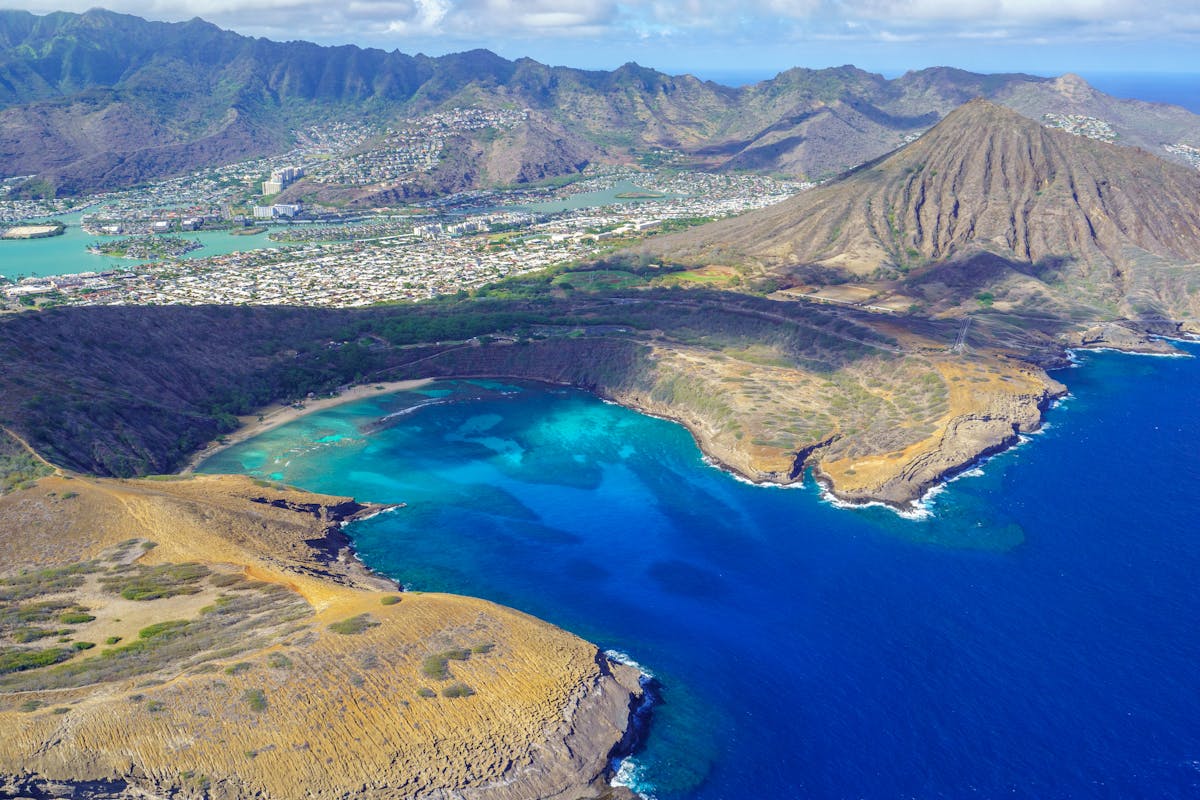
Tucked inside an ancient volcanic crater on Oahu's southeast shore, Hanauma Bay is the most protected, most beautiful, and most famous snorkeling destination in all of Hawaii. Voted Best Beach in the United States, this crescent-shaped marine sanctuary shelters over 400 species of tropical fish, Hawaiian green sea turtles, moray eels, and living coral reefs — all in water so calm and clear it feels like swimming in a giant aquarium. It's also one of Oahu's most iconic film locations, appearing on screen since Elvis Presley first waded in back in 1961.
Formed when a volcanic cone partially collapsed into the sea roughly 32,000 years ago, Hanauma Bay became Hawaii's first Marine Life Conservation District in 1967. After decades of overuse that once drew 10,000 visitors per day and decimated the reef, a landmark conservation program launched in 1990 brought it back from the brink. Today only 1,400 carefully managed visitors enter each day — making your reservation feel like a golden ticket to one of the Pacific's last pristine reef systems.
What Does "Hanauma" Mean?
The name Hanauma (pronounced hah-NOW-mah) comes from two Hawaiian words: hana (bay or curved shape) and uma (arm wrestling or curved). Together it means "curved bay" — a perfect description of the crescent shoreline cradled inside the volcanic walls. Some Hawaiian scholars also translate it as "hand-wrestling bay," a reference to the bay's distinctive shape when viewed from above, where the two curving arms of the crater look like hands locked in a traditional Hawaiian wrestling grip.
Hanauma Bay held deep cultural significance for Native Hawaiians long before tourists arrived. It was a favored fishing spot for Hawaiian royalty — ali'i — who came here to fish in waters so rich the reef was practically inexhaustible. The bay's sheltered calm also made it a gathering place for ceremonies and rest.
Swimming into Hanauma Bay feels like diving into a living painting — yellow tang, sea turtles, parrotfish and Moorish idols all around you, in water so clear you can see every grain of sand on the bottom twenty feet below.
— HI Private Tours GuideGeology: A Volcanic Crater Swallowed by the Sea
Hanauma Bay is the remnant of a volcanic tuff cone from the Honolulu Volcanic Series — the same chain of eruptions that formed Diamond Head, Punchbowl, Koko Head, and the Halona Blowhole lava tubes. An eruption approximately 32,000 years ago blasted a crater into the Koko Head peninsula. Over millennia, the seaward wall of the crater eroded and collapsed, allowing the Pacific Ocean to flood in. The result is a near-perfectly sheltered bay surrounded on three sides by steep volcanic walls, with the ocean entering through the open seaward side.
Those volcanic walls — rising up to 300 feet — are what make the bay so calm. Most wave energy is absorbed by the outer reef before it reaches the beach, creating the pool-like conditions that make it ideal for beginner snorkelers and families with children. The inner reef sits just a few feet below the surface, bringing fish face-to-face with swimmers without requiring any diving depth.
Marine Life: What You'll See
Hanauma Bay shelters more than 400 species of fish, plus sea turtles, moray eels, octopus, spotted eagle rays, and seasonal dolphins. Because fishing has been banned since 1967, the fish here have lost their fear of humans — they'll swim directly up to you in the shallows.
One Hanauma Bay fact that surprises most visitors: much of the bay's famous white sand was made by parrotfish. These colorful fish bite off chunks of coral with their beak-like teeth to eat the algae inside, then excrete the ground-up calcium carbonate as white sand. A single parrotfish can produce hundreds of pounds of sand per year. The beach you're lying on is essentially fish excrement — beautiful, powdery, and entirely natural.
How to Visit: The Reservation System
Visiting Hanauma Bay requires advance planning — it's one of the most in-demand reservations in all of Hawaii. The park is open Wednesday through Sunday only (closed Monday and Tuesday to let the reef rest), from 6:45am to 4pm, with the last entry at 1:30pm. Only 1,400 visitors per day are admitted.
⚠️ Reservations open exactly 48 hours in advance at 7:00am HST — and sell out in 15–20 minutes. Set an alarm. Book at the official Honolulu Parks & Recreation site. Entry fee: $25/person · Parking: $3/car (cash only). Children 12 & under, active military, and Hawaii residents with ID enter free. On a HI Private Tours tour, we handle all reservations and logistics for you.
Before entering the water, every visitor must watch a mandatory 9-minute educational video about the reef ecosystem, safe snorkeling behavior, and conservation rules. This is required every visit — even if you've been before. After the video, you walk (or take the free tram) down the hill to the beach.
Movies & TV Shows at Hanauma Bay
Hanauma Bay's otherworldly beauty has been drawing filmmakers since the early days of Hollywood in Hawaii. From Elvis splashing through the shallows to modern TV dramas, the bay has been a recurring backdrop for productions that needed to show paradise at its most perfect.
Elvis Presley's most commercially successful film featured Hanauma Bay as the backdrop for beach scenes that introduced the bay — and Hawaii itself — to millions of mainland Americans. The film is widely credited with sparking a tourism boom that transformed Oahu. When Chad Gates (Elvis) strums his guitar on the beach at Hanauma Bay, the image became synonymous with Hawaii's postwar paradise identity.
Elvis returned to Hanauma Bay five years after Blue Hawaii for this second Hawaiian romp, frolicking in the bay's crystal waters alongside a helicopter pilot storyline. Shot on location across Oahu, the film used Hanauma Bay prominently for its signature beach sequences — cementing the bay's status as Hollywood's go-to vision of tropical paradise.
for his second Hawaiian film
CBS's hit procedural drama — the first NCIS series with a female lead — filmed across Oahu's most iconic locations for three seasons, including Hanauma Bay and the surrounding southeast coastline. The first female Special Agent in Charge of NCIS Pearl Harbor navigated high-stakes cases against the backdrop of real Oahu locations. The show was canceled in 2024 after 3 seasons, but its use of Hanauma Bay and East Oahu brought the area to a massive global CBS audience.
From Elvis wading through the shallows to FBI agents chasing suspects along the coastline, Hanauma Bay has bookended six decades of Hollywood's love affair with Hawaii. The bay's combination of inaccessible volcanic walls, turquoise water, and white sand creates a frame so perfect that filmmakers keep returning to it generation after generation.
Satellite Map & Location
Insider Tips for the Best Visit
🐠 Pro Tips from Our Guides
- ⏰Book the 6:45am opening slot — the first entry of the day has the clearest water (no one has stirred up the sand yet), the shortest lines, and the best parking. The lot fills completely by 8am.
- 🤿Bring your own snorkel gear — rental sets at the bay cost $25. Buy a basic set before your trip and save the money. ABC Stores in Waikiki sell decent starter kits.
- 🐢Head left (northwest) along the reef — the left side of the bay (the Keyhole Lagoon and Back Door area) has calmer water, more coral diversity, and more turtle sightings than the crowded center beach area.
- ☀️Bring reef-safe sunscreen only — oxybenzone and octinoxate are banned in Hawaii. Regular sunscreen is illegal to use in the bay and will be confiscated. Use mineral-based SPF 50+ (zinc oxide or titanium dioxide).
- 🚗Parking is $3 cash only — no card payments accepted at the gate. The lot has only 300 stalls and fills by 8am even with reservations. Bring exact change or come with a tour.
- 🍱Pack your own food — the snack stand near the entrance accepts cards only and has limited options. There's nowhere to buy food on the beach itself. Bring snacks and plenty of water.
- 🪸Never touch the coral — it is living animals, extremely fragile, and illegal to damage. Use the swim channels and sandy areas marked by buoys. One touch can kill coral that took decades to grow.
- 🌊Avoid the outer reef unless you're an experienced swimmer — beyond the inner lagoon, currents and surge increase significantly. The inner reef is magical enough — there's no need to venture past the buoys.